Hey there! As an aluminum honeycomb supplier, I often get asked about the weight-to-strength ratio of aluminum honeycomb. It's a crucial factor that makes this material a top choice in various industries. So, let's dive right in and explore what this ratio is all about.
First off, what exactly is aluminum honeycomb? It's a lightweight yet incredibly strong material made up of a series of hexagonal cells. These cells are typically made from aluminum sheets and are arranged in a honeycomb pattern, which gives the material its unique structure. The Aluminum Honeycomb Core forms the heart of this material, providing the strength and stability needed for a wide range of applications.
Now, let's talk about the weight-to-strength ratio. This ratio is a measure of how much strength a material can provide relative to its weight. In the case of aluminum honeycomb, this ratio is outstanding. Aluminum itself is a relatively lightweight metal, and when it's formed into a honeycomb structure, the weight is further reduced while the strength is significantly increased.
The honeycomb structure works like a series of tiny columns. Each hexagonal cell acts as a column, distributing the load evenly across the entire structure. This means that even though the material is lightweight, it can withstand a substantial amount of force without deforming or breaking. For example, in aerospace applications, where weight is a critical factor, Aluminum Honeycomb is used extensively because of its excellent weight-to-strength ratio. It allows aircraft to be lighter, which in turn reduces fuel consumption and increases efficiency.
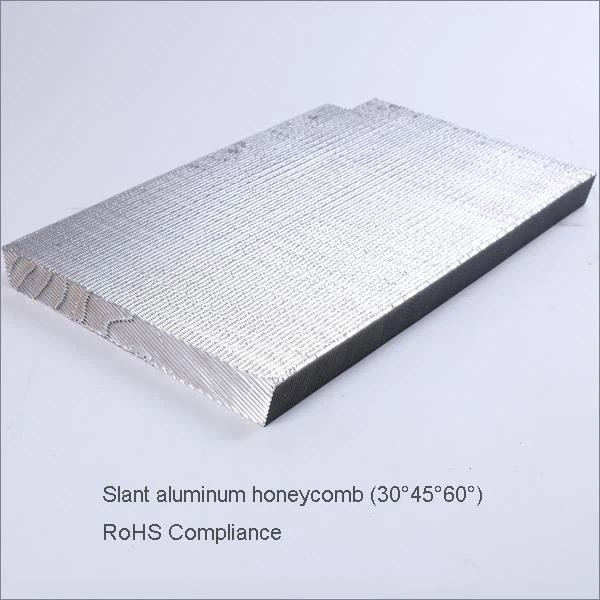
Another great thing about the weight-to-strength ratio of aluminum honeycomb is its versatility. It can be used in a wide variety of industries, from automotive to construction. In the automotive industry, it's used to make lightweight yet strong parts, such as body panels and interior components. This helps to improve the fuel efficiency of vehicles while also enhancing safety. In construction, Slant Aluminum Honeycomb can be used in building facades, roofing, and partitions. Its high strength and low weight make it easy to install and can reduce the overall load on the building structure.

Let's take a closer look at some of the technical aspects of the weight-to-strength ratio. The strength of aluminum honeycomb is typically measured in terms of its compressive strength, shear strength, and flexural strength. Compressive strength refers to the ability of the material to withstand a pushing force, while shear strength is its ability to resist a sliding force. Flexural strength, on the other hand, measures the material's ability to bend without breaking.
The weight of aluminum honeycomb can be adjusted by changing the thickness of the aluminum sheets used to make the cells and the size of the cells themselves. By carefully controlling these factors, we can create aluminum honeycomb with a wide range of weight-to-strength ratios to suit different applications. For example, if a high-strength application is required, we can use thicker aluminum sheets and smaller cells. Conversely, for applications where weight is the primary concern, we can use thinner sheets and larger cells.
One of the advantages of using aluminum honeycomb is its durability. Aluminum is a corrosion-resistant metal, which means that the honeycomb structure can withstand harsh environmental conditions without deteriorating. This makes it a long-lasting solution for outdoor applications, such as in marine and transportation industries.
In addition to its excellent weight-to-strength ratio and durability, aluminum honeycomb is also easy to work with. It can be cut, drilled, and shaped using standard tools, which makes it a popular choice for designers and manufacturers. This ease of fabrication allows for greater flexibility in design and can help to reduce production costs.
Now, let's compare aluminum honeycomb with some other materials. When compared to traditional materials like steel and wood, aluminum honeycomb offers a much better weight-to-strength ratio. Steel is a strong material, but it's also very heavy. Wood, on the other hand, is lightweight but may not have the same level of strength and durability as aluminum honeycomb. This makes aluminum honeycomb a more efficient and cost-effective choice in many applications.
If you're in an industry that requires a material with a high weight-to-strength ratio, aluminum honeycomb could be the perfect solution for you. Whether you're in aerospace, automotive, construction, or any other industry, our company can provide you with high-quality aluminum honeycomb products. We have a wide range of options available, including different cell sizes, sheet thicknesses, and surface finishes to meet your specific needs.
If you're interested in learning more about our aluminum honeycomb products or would like to discuss a potential project, please don't hesitate to get in touch. We're always happy to answer your questions and provide you with a quote. You can start exploring our product range on our website and see for yourself the benefits of using aluminum honeycomb.
In conclusion, the weight-to-strength ratio of aluminum honeycomb is one of its most significant advantages. It offers a lightweight yet strong solution for a wide range of applications, making it a popular choice in many industries. Its durability, ease of fabrication, and corrosion resistance further enhance its appeal. So, if you're looking for a high-performance material, consider aluminum honeycomb.
References
- "Aluminum Alloys: Structure and Properties" by John W. Martin
- "Advanced Composites for Aerospace Engineering" by R. V. Kumar