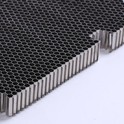
Flexural strength is a critical mechanical property that measures a material's ability to resist bending under load. When it comes to SS honeycomb core, understanding its flexural strength is essential for a wide range of applications. As a supplier of SS honeycomb core, I am well - versed in the details of this remarkable material and its flexural strength characteristics.
Understanding Flexural Strength
Flexural strength, also known as bend strength or modulus of rupture, is determined by applying a load to a specimen in a way that causes it to bend. For SS honeycomb core, this involves subjecting a section of the honeycomb structure to a three - point or four - point bending test. During these tests, the honeycomb core is supported at two points and loaded at one or two additional points, creating a bending moment.
The flexural strength of a material is typically expressed in units of stress, such as megapascals (MPa) or pounds per square inch (psi). It represents the maximum stress that the material can withstand before it fails under bending. For SS honeycomb core, a high flexural strength is desirable as it indicates the core's ability to maintain its shape and integrity when subjected to bending forces in real - world applications.
Factors Affecting the Flexural Strength of SS Honeycomb Core
Several factors influence the flexural strength of SS honeycomb core. One of the most significant factors is the cell size of the honeycomb. Smaller cell sizes generally result in higher flexural strength because they provide more support and distribute the load more evenly across the structure. In contrast, larger cell sizes may offer reduced weight but can lead to lower flexural strength.
The thickness of the stainless - steel foil used to construct the honeycomb core also plays a crucial role. Thicker foils typically contribute to higher flexural strength as they are more resistant to deformation. However, increasing the foil thickness also adds weight to the honeycomb core, which may be a limiting factor in applications where weight is a concern, such as aerospace or automotive industries.
The material properties of the stainless steel itself are another important factor. Different grades of stainless steel have varying mechanical properties, including strength and ductility. For example, austenitic stainless steels, such as 304 and 316, are commonly used in honeycomb core production due to their good corrosion resistance and relatively high strength. The heat treatment and manufacturing processes applied to the stainless - steel foil can also affect its mechanical properties and, consequently, the flexural strength of the honeycomb core.
Measuring the Flexural Strength of SS Honeycomb Core
To accurately measure the flexural strength of SS honeycomb core, standardized testing methods are employed. The most common test methods include three - point and four - point bending tests, as described by international standards such as ASTM C393.
In a three - point bending test, the honeycomb core specimen is supported at two ends and loaded at the center. The load is gradually increased until the specimen fails, and the maximum load and the corresponding deflection are recorded. The flexural strength can then be calculated using the appropriate formula based on the dimensions of the specimen and the applied load.
Four - point bending tests are similar, but the load is applied at two points between the supports. This type of test provides a more uniform bending moment across the specimen and can be more representative of real - world loading conditions.
Applications and the Importance of Flexural Strength
The flexural strength of SS honeycomb core is of utmost importance in a variety of applications. In the aerospace industry, Stainless Steel Honeycomb is used in aircraft structures, such as wing panels and fuselage components. These components are subjected to significant bending forces during flight, and the high flexural strength of the honeycomb core ensures their structural integrity and safety.
In the automotive industry, Metal Honeycomb is used in lightweight body panels and crash - energy management systems. The flexural strength of the honeycomb core helps these components withstand the stresses of normal driving and impact events, improving the overall safety and performance of the vehicle.
Architectural applications also benefit from the flexural strength of SS honeycomb core. It is used in building facades, interior partitions, and roofing systems. The honeycomb core provides a lightweight yet strong solution that can support the weight of cladding materials and resist wind and other environmental loads.
Benefits of High Flexural Strength in SS Honeycomb Core
High flexural strength in SS honeycomb core offers several benefits. Firstly, it allows for the design of lighter structures without sacrificing strength. This is particularly important in industries where weight reduction is a key goal, such as aerospace and automotive. By using SS honeycomb core with high flexural strength, manufacturers can reduce the overall weight of their products, leading to improved fuel efficiency, lower operating costs, and better performance.
Secondly, high flexural strength enhances the durability and reliability of the honeycomb core. Structures made with SS honeycomb core can withstand repeated bending and loading cycles without significant deformation or failure. This reduces the need for frequent maintenance and replacement, resulting in long - term cost savings.
Customizing SS Honeycomb Core for Specific Flexural Strength Requirements
As a supplier of SS honeycomb core, we understand that different applications have unique requirements for flexural strength. That's why we offer customized steel honeycomb core solutions to meet the specific needs of our customers.


Our team of experts can work closely with you to determine the optimal cell size, foil thickness, and stainless - steel grade for your application. We use advanced manufacturing techniques to produce honeycomb core with precise specifications, ensuring that it meets or exceeds your desired flexural strength requirements.
Contact Us for Your SS Honeycomb Core Needs
If you are in need of SS honeycomb core with specific flexural strength requirements, we are here to help. Our extensive experience in the industry and commitment to quality make us a reliable partner for your honeycomb core needs. Whether you are in the aerospace, automotive, architectural, or any other industry, we can provide you with high - quality SS honeycomb core that meets your performance and cost requirements.
Feel free to reach out to us to discuss your project in detail. We look forward to the opportunity to work with you and contribute to the success of your applications.
References
- ASTM International. (Year). ASTM C393 - Standard Test Method for Flexural Properties of Sandwich Constructions.
- Callister, W. D., & Rethwisch, D. G. (Year). Materials Science and Engineering: An Introduction. Wiley.
- ASM Handbook Committee. (Year). ASM Handbook, Volume 1: Properties and Selection: Irons, Steels, and High - Performance Alloys. ASM International.