What is the Young's modulus of aluminum honeycomb?
As a dedicated supplier of aluminum honeycomb products, I often encounter inquiries about the Young's modulus of aluminum honeycomb. This parameter is crucial for understanding the mechanical properties and performance of aluminum honeycomb in various applications. In this blog post, I'll delve into the concept of Young's modulus, explain its significance for aluminum honeycomb, and provide insights into how it impacts the use of our products.
Understanding Young's Modulus
Young's modulus, also known as the elastic modulus, is a fundamental property of materials that describes their stiffness or resistance to elastic deformation under stress. It is defined as the ratio of stress (force per unit area) to strain (deformation per unit length) within the elastic range of a material. Mathematically, it can be expressed as:
[ E = \frac{\sigma}{\epsilon} ]
Where ( E ) is the Young's modulus, ( \sigma ) is the stress, and ( \epsilon ) is the strain. The unit of Young's modulus is typically pascals (Pa) or gigapascals (GPa).
A high Young's modulus indicates that a material is stiff and requires a large amount of stress to produce a small amount of strain. Conversely, a low Young's modulus means that the material is more flexible and can undergo significant deformation under relatively low stress.
Young's Modulus of Aluminum Honeycomb
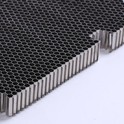
Aluminum honeycomb is a composite material consisting of a honeycomb - structured core made of aluminum foil sandwiched between two face sheets. The Young's modulus of aluminum honeycomb depends on several factors, including the properties of the aluminum used in the core, the geometry of the honeycomb cells, and the thickness and material of the face sheets.
The Young's modulus of the aluminum alloy used in the honeycomb core typically ranges from about 68 to 72 GPa. However, the overall Young's modulus of the aluminum honeycomb panel is much lower than that of the solid aluminum due to the honeycomb structure. The honeycomb design provides a high strength - to - weight ratio by distributing the load over a large area, but it also reduces the stiffness compared to a solid block of aluminum.


The geometry of the honeycomb cells, such as the cell size, cell wall thickness, and cell shape, has a significant impact on the Young's modulus. Smaller cell sizes and thicker cell walls generally result in a higher Young's modulus because they provide more support and resistance to deformation. Additionally, the orientation of the honeycomb cells relative to the applied load can also affect the stiffness. For example, a honeycomb panel with cells oriented parallel to the load direction will have a different Young's modulus than one with cells oriented perpendicular to the load.
The face sheets of the aluminum honeycomb panel also contribute to the overall stiffness. Thicker and stiffer face sheets can increase the Young's modulus of the panel by providing additional support and distributing the load more effectively.
Importance of Young's Modulus in Applications
The Young's modulus of aluminum honeycomb is a critical factor in many applications. In aerospace, for instance, where weight reduction is of utmost importance, aluminum honeycomb panels are used in aircraft interiors, wings, and fuselages. A proper understanding of the Young's modulus helps engineers design structures that can withstand the required loads while keeping the weight to a minimum. By choosing an aluminum honeycomb with the appropriate Young's modulus, they can ensure the structural integrity of the aircraft components.
In the automotive industry, aluminum honeycomb is used in parts such as body panels and crash structures. The Young's modulus affects how the parts respond to impacts and vibrations. A higher Young's modulus can provide better resistance to deformation during a collision, enhancing the safety of the vehicle.
In the construction industry, aluminum honeycomb panels are used for cladding, partitions, and ceilings. The Young's modulus determines the panel's ability to resist bending and sagging under its own weight and external loads such as wind and snow. Architects and engineers need to select panels with the right Young's modulus to ensure the long - term stability and appearance of the building.
Our Aluminum Honeycomb Products and Young's Modulus
At our company, we offer a wide range of aluminum honeycomb products, including Aluminium Honeycomb Core Slices, Nomex Honeycomb Core For Sale, and Aluminum Honeycomb Core. We understand the importance of Young's modulus in different applications and work closely with our customers to provide products that meet their specific requirements.
We have advanced manufacturing processes that allow us to control the geometry of the honeycomb cells and the properties of the face sheets precisely. This enables us to produce aluminum honeycomb panels with a wide range of Young's moduli to suit various needs. Whether you need a stiff panel for a high - load application or a more flexible panel for a curved surface, we can customize our products accordingly.
Contact Us for Your Aluminum Honeycomb Needs
If you are interested in our aluminum honeycomb products and need more information about their Young's modulus or other mechanical properties, we encourage you to get in touch with us. Our team of experts is ready to assist you in selecting the right product for your project. We can provide detailed technical specifications, samples, and cost estimates. Whether you are in the aerospace, automotive, construction, or any other industry, we are confident that our aluminum honeycomb products can meet your expectations. Start a conversation with us today to explore the possibilities of using our high - quality aluminum honeycomb in your next project.
References
- Ashby, M. F., & Jones, D. R. H. (2005). Engineering Materials 1: An Introduction to Properties, Applications, and Design. Butterworth - Heinemann.
- Gibson, L. J., & Ashby, M. F. (1997). Cellular Solids: Structure and Properties. Cambridge University Press.
- Schajer, G. S. (2018). Mechanics of Materials. McGraw - Hill Education.