As a seasoned supplier of honeycomb aluminum, I've witnessed firsthand the intricate relationship between the size of honeycomb cells and the properties of honeycomb aluminum. This relationship is not only fascinating from a scientific perspective but also has significant implications for various industries that rely on this remarkable material.
The Basics of Honeycomb Aluminum
Honeycomb aluminum is a lightweight, high - strength material composed of a series of hexagonal cells. These cells are typically made from thin aluminum sheets, which are bonded together to form a rigid structure. The unique hexagonal shape of the cells provides excellent structural stability, making honeycomb aluminum an ideal choice for applications where weight reduction and strength are crucial.
Impact of Cell Size on Density
One of the most obvious ways in which cell size affects honeycomb aluminum is its density. Smaller cell sizes generally result in a higher density honeycomb structure. This is because there are more cells per unit volume, and the thin aluminum walls that make up the cells contribute to the overall mass. For applications where a higher density is required, such as in some aerospace components where additional weight can be tolerated for increased strength, smaller cell sizes are often preferred.
On the other hand, larger cell sizes lead to a lower density honeycomb. This makes the material lighter, which is highly desirable in industries like automotive and marine, where weight reduction is a key factor in improving fuel efficiency and performance. For example, in the construction of racing cars, using honeycomb aluminum with larger cell sizes can significantly reduce the vehicle's weight without sacrificing too much strength.
Influence on Strength and Stiffness
The strength and stiffness of honeycomb aluminum are also closely related to the cell size. Smaller cell sizes typically offer greater strength and stiffness. The increased number of cell walls in a smaller - cell honeycomb provides more resistance to deformation. When a load is applied, the load is distributed more evenly across the numerous cell walls, allowing the material to withstand higher forces without failing.
In applications such as aircraft wings and fuselage panels, where high strength and stiffness are essential to ensure the safety and performance of the aircraft, honeycomb aluminum with smaller cell sizes is commonly used. However, it's important to note that the manufacturing process for smaller - cell honeycombs can be more complex and costly.
Larger cell sizes, while offering lower density, generally have lower strength and stiffness compared to their smaller - cell counterparts. But in some applications where the loads are relatively low, such as in interior partitions of buildings or some consumer product casings, the reduced strength may be acceptable in exchange for the weight savings.
Effect on Thermal and Acoustic Properties
Cell size also plays a role in the thermal and acoustic properties of honeycomb aluminum. Smaller cell sizes can enhance the thermal insulation properties of the material. The numerous small cells act as barriers to heat transfer, reducing the rate at which heat can pass through the honeycomb structure. This makes honeycomb aluminum with smaller cell sizes suitable for applications where thermal insulation is important, such as in refrigeration units or in the walls of energy - efficient buildings.
In terms of acoustic properties, smaller cell sizes can provide better sound absorption. The complex network of small cells can trap sound waves, converting their energy into heat through friction with the cell walls. This makes it useful in environments where noise reduction is required, like recording studios or industrial facilities.
Larger cell sizes, on the other hand, may have less effective thermal and acoustic insulation. However, they can still offer some level of insulation, and in some cases, the lower density of the larger - cell honeycomb can be beneficial for allowing air circulation, which may be important in certain ventilation - related applications.

Manufacturing Considerations Based on Cell Size
The manufacturing process of honeycomb aluminum is also affected by cell size. Producing honeycomb with smaller cell sizes requires more precise manufacturing techniques. The bonding of the thin aluminum sheets to form the cells needs to be highly accurate to ensure the integrity of the small cells. This often involves more advanced machinery and skilled labor, which can increase the production cost.
For larger cell sizes, the manufacturing process is relatively less complex. The bonding process is more forgiving, and the overall production can be more efficient. This makes larger - cell honeycomb aluminum more cost - effective for mass - production applications.
Applications Based on Cell Size
Depending on the cell size, honeycomb aluminum finds a wide range of applications. For smaller cell sizes, as mentioned earlier, aerospace is a major industry. Components like aircraft wings, floors, and bulkheads often use honeycomb aluminum with small cells for its high strength - to - weight ratio and excellent stiffness. The Aluminium Honeycomb Core Blocks with small cell sizes are well - suited for these critical aerospace applications.
In the automotive industry, larger cell sizes are commonly used. Interior panels, seat frames, and some non - structural components can benefit from the weight savings provided by larger - cell honeycomb aluminum. The Grooved Aluminum Honeycomb with larger cell sizes can be easily customized for different automotive design requirements.
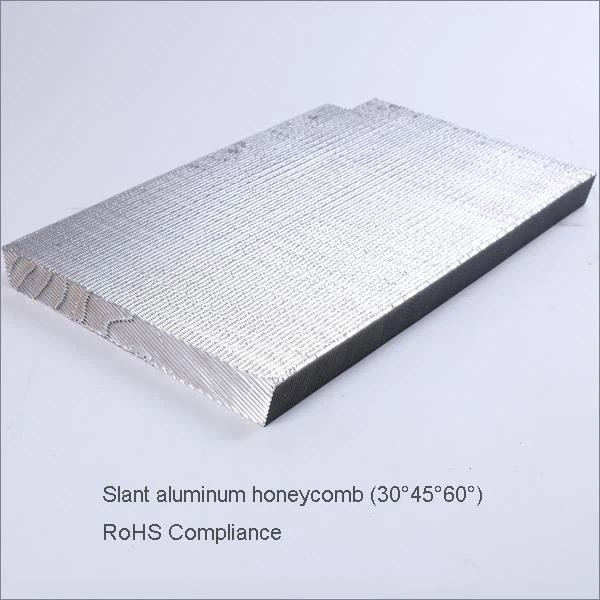
In the construction industry, both small and large cell sizes have their uses. Small - cell honeycomb can be used in high - performance facades where strength and thermal insulation are important. Larger - cell honeycomb can be used in interior partitions for its lightweight and cost - effectiveness. The Slant Aluminum Honeycomb can offer unique design options for both interior and exterior construction applications.
Conclusion
In conclusion, the size of honeycomb cells has a profound impact on the properties of honeycomb aluminum. From density and strength to thermal and acoustic properties, each aspect is influenced by the cell size. As a honeycomb aluminum supplier, understanding these relationships is crucial for providing the right product to our customers.
Whether you are in the aerospace, automotive, construction, or any other industry that can benefit from honeycomb aluminum, we can offer a wide range of cell sizes to meet your specific requirements. Our team of experts can help you choose the most suitable honeycomb aluminum based on your application's needs, considering factors such as strength, weight, cost, and performance.
If you are interested in learning more about our honeycomb aluminum products or would like to discuss a potential purchase, please feel free to reach out to us. We are eager to start a conversation and work with you to find the perfect honeycomb aluminum solution for your project.
References
- Gibson, L. J., & Ashby, M. F. (1997). Cellular Solids: Structure and Properties. Cambridge University Press.
- Rohatgi, P. K. (Ed.). (2001). Handbook of Aluminum Matrix Composites: Processes, Applications, and Properties. ASM International.
- Wicks, A. W., & Light, M. C. (2003). Advanced Materials Technology for Automotive Applications. Society of Automotive Engineers.